
Peons in Hell (Jasper County, Georgia 1921)

In early 1921, federal agents George Brown and A.J. Wismer visited John S. Williams’s 2,000-acre plantation in Jasper County, Georgia, to investigate reports of peonage—the practice of forcing men to work off jail fines through forced labor. Williams and his sons had routinely bonded out Black prisoners for minor offenses and forced them to work off the debt under threat of violence.
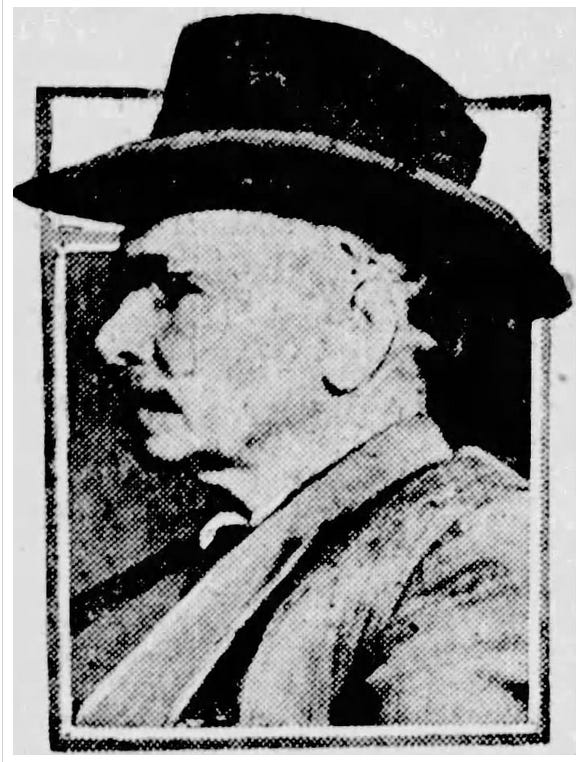
John S. Williams, Atlanta Journal, March 28, 1921 p.1.
During their visit, the agents questioned Clyde Manning, the black foreman, about whether he and Williams had recaptured a laborer named Gus Chapman. Manning denied it, though others later confirmed Chapman had been forcibly returned and stabbed. When the agents explained that this system paying a fine and compelling labor was illegal, Williams was shocked, stating that “most of the farmers in this county must be guilty of peonage.” The agents made no arrests thinking they’d made their point. Williams privately told Manning they would “have to do away with these negroes” to prevent them from testifying.
On March 13, 1921, a boy discovered a body in the Yellow River. Two murdered Black men were recovered, bound and weighed down to make their corpses sink. The trail led back to the Williams plantation, revealing not just murder but a brutal system of modern-day slavery. Laborers were confined in “stockades,” beaten regularly, and denied freedom even after repaying their debt. Manning and Claude Freeman, another black manager, were armed and ordered to control the workers.
Discipline was vicious. Survivors recounted routine beatings for minor offenses, and women on the farm, both free and imprisoned, were also whipped and assaulted. Though some tried to escape, it was almost hopeless as they were hunted down with bloodhounds and beaten again. It was an environment of pure terror and desperation for the workers, although common and acceptable to the farm owners; it’s just the way it was.
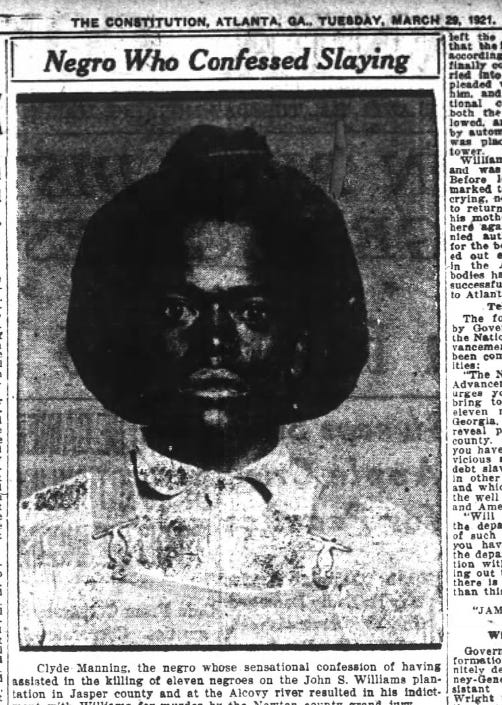
Two men—Gus Chapman and James Strickland—escaped in late 1920 and filed complaints with the Justice Department, prompting the agents’ February visit. Afterward, Williams sent his sons away and began murdering the laborers. Manning participated. Johnny Williams, the first victim, was struck in the head with an ax. Over the next days, others were axed or thrown off bridges with sacks of rocks chained around their necks. Manning later confessed to helping kill eleven men, saying he acted out of fear for his own life.
Manning’s confession, given under protection in Atlanta on March 24, led to the full exposure of the crimes. Authorities, shocked and embarrassed, launched a public investigation.
Bodies of the black victims were recovered. Rumors spread of black uprisings and local whites responded in panic. Mobs of white men formed posses to fight the imminent race battle. They found the black folks holding a prayer meeting by the river.
Federal agents Brown and Wismer testified but gave evasive accounts, claiming they lacked the authority to arrest Williams. It almost seemed unfair to arrest him when everyone did the same thing.
Williams testified in his defense, blaming Manning as if he had killed all these men of his own accord. In fact, much of the reporting of the time concerned with whether Williams had conspired with Manning, or if Manning acted alone.
On April 9, 1921, Williams was found guilty of murder and sentenced to life in prison. It marked the first time a white man in the South had been convicted for murdering a Black man since 1877. (See that story here).
Manning, too, was sentenced to life even though he acted under coercion. He later died on a chain gang.
In an ironic twist on his wickedness, Williams was killed years later at a prison camp attempting to stop a jailbreak.
Sources: My main information comes from The Shadow of Slavery: Peonage in the South, 1901-1969 by Pete R. Daniel (Univ. Ill. 1990); there is another good article here; also a book about the subject here